
Microbiological Water Quality Testing Methods for
E. coli and Total Coliform Bacteria
Introduction
Many different types of bacteria can be found in drinking water samples. However, there are individual bacteria and groups of bacteria of particular concern that are indicative of risks to human health because they can cause illness and even death.
The greatest microbial waterborne risk to health is from ingestion of fecal pathogens in drinking water. Ongoing, routine water quality testing is crucial to ensure safe drinking water. Ongoing water quality monitoring also enables successful development and maintenance of sustainable water, sanitation and hygiene (WASH) systems and services, and water safety planning.
The World Health Organization (WHO) Guidelines for Drinking Water Quality recommend the bacterium E. coli as the preferred indicator organism to test for fecal contamination in 100 mL water samples. Their guidelines say there should be zero E. coli bacteria in a 100 mL drinking water sample for it to be considered safe to drink.
However, the WHO does not recommend testing methods such as presence/absence vs. quantified tests that give bacteria concentrations or counts, nor do they recommend specific testing products. Their primary recommendation for microbial testing is there should be no E. coli in 100 mL water samples.
The World Health Organization (WHO) Guidelines for Drinking Water Quality recommend the bacterium E. coli as the preferred indicator organism to test for fecal contamination in 100 mL water samples. Their guidelines say there should be zero E. coli bacteria in a 100 mL drinking water sample for it to be considered safe to drink. However, the WHO does not recommend testing methods such as presence/absence vs. quantified tests that give bacteria concentrations or counts, nor do they recommend specific testing products. Their primary recommendation for microbial testing is there should be no E. coli in 100 mL water sample.
Brief Summary of Types of Bacteria in Water Samples
Total Coliforms are a large group of bacteria that includes E. coli, thermotolerant (fecal) coliforms and other bacteria, many of which are not of fecal origin. Total coliform counts only give a general indication of the sanitary condition of a water supply.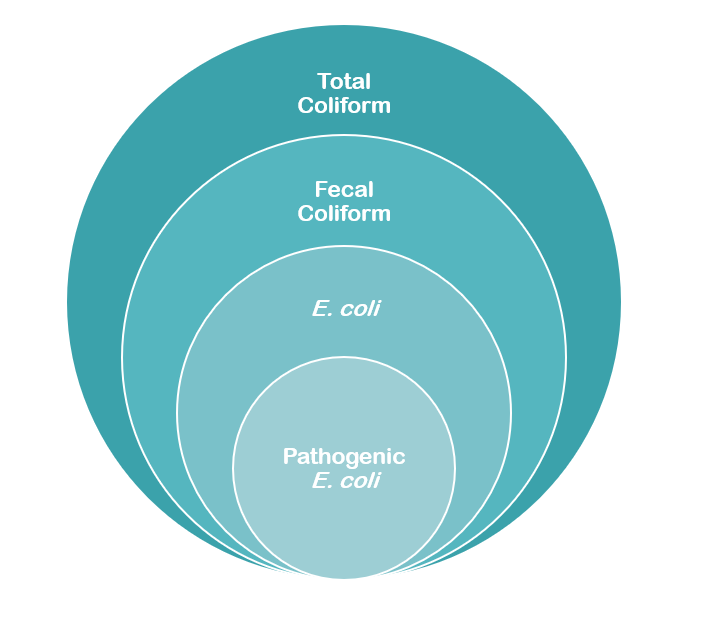
Fecal Coliforms, also called thermotolerant coliforms, are the group of total coliforms considered to be present specifically in the gut and feces of humans and warm-blooded animals. They are detected at an elevated incubation temperature that excludes detection of non-fecal total coliforms.
Because the origins of fecal coliforms are more specific than the origins of the more general total coliform group of bacteria, fecal coliforms are considered a more reliable indication of the presence of human or animal waste than total coliforms.
E. coli is considered the most fecal-specific species in the fecal coliform group.
Why E. coli is the Recommended Indicator Organism
The concentrations of pathogens in a water sample can be low, making them difficult to detect. 
In addition, the number of different pathogens is very large, making it impractical to detect all of them.
Therefore, we use “indirect evidence” of potential pathogen presence by determining the presence, concentrations or counts of indicator organisms in water samples.
Of the several different groups of bacteria that comprise the total coliform group, only E. coli generally is not found growing and reproducing in the environment. It usually is introduced into environments such as water via the feces of humans and warm-blooded animals.
Presence/Absence Water Quality Tests
Presence/Absence (P/A) tests provide “yes” or “no” (i.e., positive or negative) results when testing for the presence of E. coli and total coliforms bacteria. The Aquagenx CBT EC+TC P/A Kit is a presence/absence test.
P/A tests detect only the presence of bacteria but do not quantify the quantity or concentration of bacteria in the water sample. They are simple procedures that do not require a lot of extra equipment and can be done at a range of temperatures for incubation.
The best applications for P/A tests are in situations when most samples are expected to provide negative test results for E. coli, and when waters are usually uncontaminated, such as testing treated drinking water.
When higher numbers of samples generate positive test results, quantitative testing methods are preferred to determine the actual concentration of bacteria in water samples and thereby give an estimate of the magnitude of health risk from the water.
Although P/A tests are acceptable for certain applications, they provide less information about the potential magnitude of health risk of water that is necessary when trying to identify causes of and solutions for fecal contamination of drinking water.
Quantified Water Quality Tests
Quantified testing methods are much more useful from a health risk estimation point of view to make more informed decisions about water safety. It is critical to know the concentration of E. coli in a water sample to determine the magnitude of health risk from the water.
Data obtained from quantified tests helps prioritize corrective actions for water supplies, such as improving or increasing treatment or finding a higher quality water source. Quantified water quality data helps determine the most effective use of water resources and provides quantitative evidence to make decisions about treating contaminated water sources in the most effective ways.
Quantified test results also are useful if water sources are at risk of intermittent contamination after collection or water treatment, which changes water quality over time.
Rainfall also can cause fecal contamination of water from land surface run-off or storm drains that carry contamination to surface water sources or supplies, such as rivers, lakes and ponds.
Groundwater sources can be more difficult to assess for E. coli contamination, as their risk of ffecal contamination may depend on local geohydrological conditions, including:
- fecal waste sources and their potential to impact the ground water by infiltration of fecal
wastes from the land surface - fecal wastes from nearby latrines or other on-site waste management sources such as
septic tank-soil infiltration (absorption) systems - animal fecal wastes (manure)
- poorly constructed and maintained wells, especially open wells
- direct wastewater infiltration systems that deliver fecal wastes into ground water
There are two primary testing methods that generate quantified test results for E. coli and total coliforms, namely Most Probable Number (MPN) quantal methods and bacterial colony enumeration methods that give direct counts as Colony Forming Units (CFU).
Most Probable Number Quantal Method to Estimate Bacteria Concentrations
The Most Probable Number (MPN) method is a statistical method that provides estimates of bacteria concentrations based on the Poisson distribution and the use of Bayesian statistics.
The Poisson distribution and MPN principles make it possible to estimate the probability of having or not having one or more bacteria in a specific volume of water that is subjected to culturing for the presence or absence of those bacteria.
All MPN testing methods employ multiple volumes of the water sample with added bacteria culture media. With the Aquagenx CBT EC+TC MPN Kit, the sample is dispensed into the Aquagenx Compartment Bag. Other tests dispense the sample into glass test tubes, or wells in plates or trays or other vessels.
Based on which and how many water volumes are positive or negative for the growth of the target bacteria after an incubation period during which the bacteria multiply, the concentration of bacteria is estimated as a MPN value and an Upper (and if desired a Lower) 95% Confidence Level (CL).
With any MPN method or product, these two quantification parameters are used together to estimate the health risk level. Test results are comprised of both the MPN concentration and the level of uncertainly of the risk estimate based on the corresponding MPN value of the Upper 95% CL.
The Upper 95% CL is the highest possible MPN value that could be present in the water sample if the same sample is tested repeatedly many times. That is, the "true" concentration of bacteria in the sample will be at or below the 95% CL value 95 times out of 100 repeated tests. It represents a worst-case upper limit of the quality of the water that would not be exceeded 95 times out of 100 on average, if the same sample is analyzed over and over again.
For more than 100 years, MPN water quality tests have been commonly used and widely accepted globally, both in the lab and in the field. Some scientists and practitioners classify MPN test results as “semi-quantitative” because MPN values are estimates of concentrations of bacteria.
Colony Forming Units Based on Counting Target Bacteria Colonies
Colony Forming Units (CFU) test results are obtained by literally counting the number of E. coli colonies in a sample. Because users count E. coli colonies in the sample in these tests using solidified culture media, CFU tests are considered “quantitative.”
Before the arrival of the Aquagenx GEL EC CFU Kit, a field test that generates CFU test results for E. coli in 100 mL water samples, this typically has been done by membrane filtration methods.
In membrane filtration methods, the water sample is first filtered through a membrane filter, usually composed of cellulose esters, which has a sufficiently small pore size to retain the bacteria in the water sample on the surface of the filter.
The water and its dissolved constituents go through the filter. The filtration process is done by either pulling the water sample through the membrane filter by vacuum filtration or pushing the water through the filter with a large syringe.
The filter is placed on a culture plate of medium that allows the retained individual bacteria to grow and multiply during an incubation period and form visible bacteria colonies. The colonies
are then counted.
Membranes with retained bacteria usually are placed on absorbent pads saturated with bacteria culture medium or on agar medium plates of the culture medium. After incubation, users count the number of bacteria colonies on a pad or agar plate to determine the bacteria concentration.
An alternative format for counting bacteria colonies in a water sample is to mix the water sample with a liquid culture medium that solidifies after several minutes in a culture plate, a tray or a clear plastic bag. Individual bacteria can then grow and multiply in the solidified, gelled medium to form visible colonies after an incubation period. Bacteria colonies that form are counted to determine the bacteria concentration.
Typically, culture media contain molten agar for colony enumeration methods in culture plates or wells. The disadvantage of agar media is the media must first be boiled or autoclaved to dissolve the agar in the culture medium. This is impractical or even impossible to do in low resource settings in the field.
Choosing Testing Methods
There are multiple factors to consider in choosing testing methods for E. coli and total coliforms, such as what type of water sources you are testing, what you are trying to accomplish by water testing, and what resources are available for testing.
The WHO Guidelines for Drinking Water Quality recommend water safety plans (WSPs) as the most effective method to consistently ensure safe drinking water supplies. WSPs require a risk assessment including all steps in water supply from catchment to consumer, followed by implementation and monitoring of risk management control measures, with a focus on high priority risks. Assessing and effectively managing microbial risks in drinking water supplies requires regular and repeated water testing for E. coli, as a key element of a WSP.
Where risks cannot be immediately addressed, the WSP incorporates implementation of incremental improvements systematically over time. WSPs always should be implemented within a public health context with clear health-based targets and water quality checks through independent surveillance.
WSPs are adaptable to all types and sizes of water supplies and can be applied in all socioeconomic settings. The water safety planning approach is increasingly being adopted globally as best practice for the provision of safe drinking water.